

SALVAGED
written by Aries, artwork by Sid (@siningnisid)


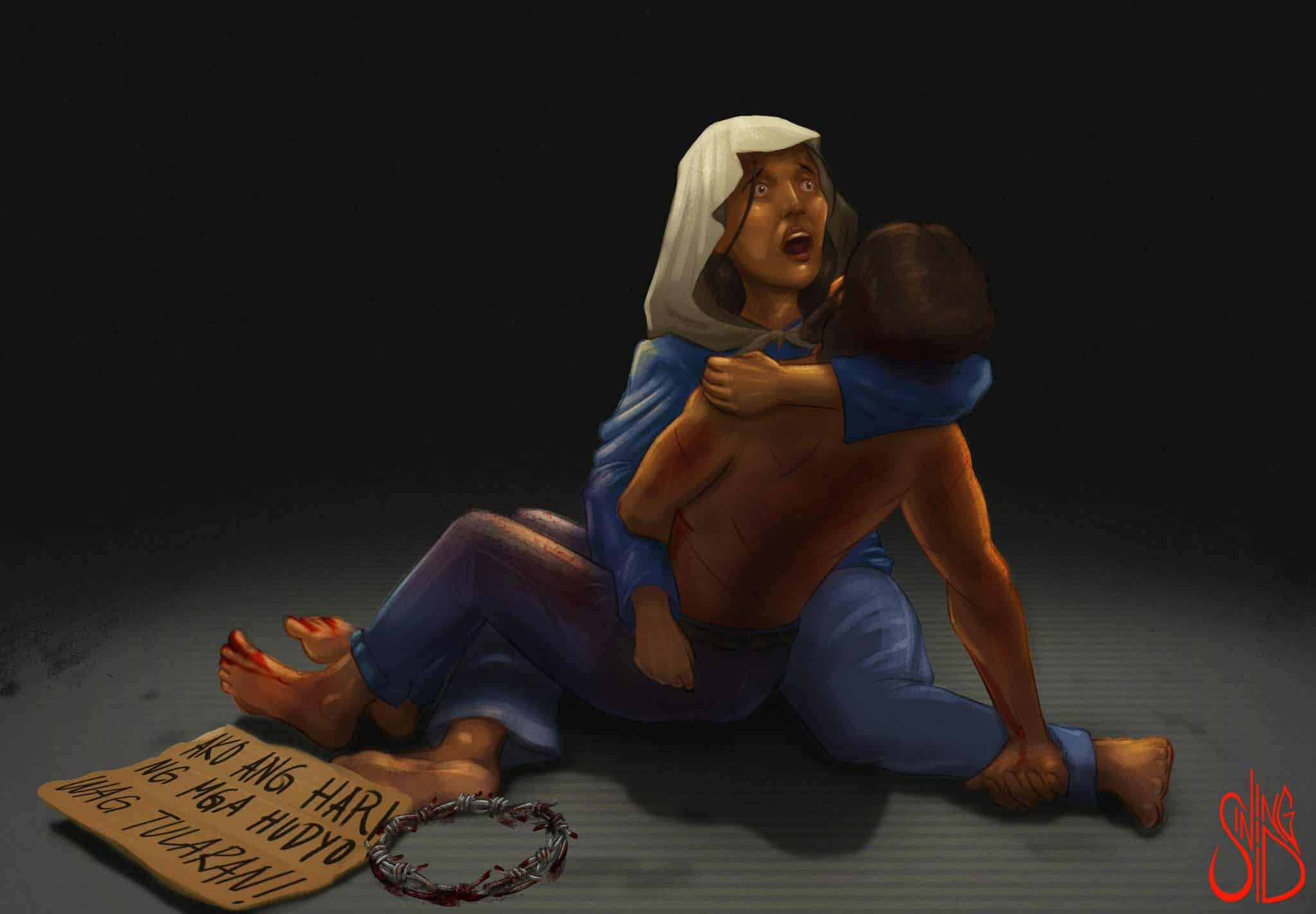
Note: This piece captures the tumultuous and brutal years of President Rodrigo Duterte’s term in the Philippines, when the so-called “war on drugs” unleashed rampant killings across the country. Thousands were slain in police operations and vigilante-style executions, many under the justification of nanlaban (“fought back”), notoriously trickling grieving families and communities in its aftermath, wallowed by fear, injustice, and impunity.
July 2017, Philippines
By the time the sun rises, the city has already decided who deserved to die. Mama always warned me that no one could play God, but Papa, unshaven and tired, would always retort: men could. That line has sticked with me, returning every time the city howls with another bullet. Another fleshy scrape on the road. Another dull thud.
It’s 8 a.m. now. As with every morning, the alley behind the bakery smells fake. Pandesal wafts over the bleach and blood trapped in the cement. This is the fourth time I’ve seen kids scrubbing the same square of pavement. Usually, they’re behind the glass pastry cases, chitchatting with mothers, old men, and early hustlers on their way to pinch bread into their coffee. Today, they’re down on their knees, arms trembling, their grandmother watching. Their fingers play with mortality instead of marbles or plastic cars.
I can almost feel my own skin being rubbed raw as the concrete crackles under their sponges. The radio from the window snags my blazer with the morning news: another nanlaban (“fought back”), another salvaged (extrajudicial killing), another cleaning operation. I realize the only human thing about the scene is there’s no tableau of a dead body.
Already, there’s a call. My editor has gotten wind of the news. With my hair still damp, lipstick uneven, my name still misshapen in her mouth, I already know what she’s going to say: Write.
I linger by the nearby sari-sari store. Sachets of junk food and plastic-wrapped shampoos glitter in their maximalism. A candle burns beside a chipped Santo Niño, its melted wax pooling on the concrete.
An old woman watches the kids washing the blood away. She says, “Kawawa naman ang mga batang ’yan. Nakakita ng kamatayan nang ganyan. Ngayon, sila pa ang naglilinis ng kalat ni Satanas.” (“Those poor children. To see death like that. And now they’re the ones cleaning up Satan’s mess.”) A smoker buys a Marlboro pack, his knees jittering as he combs through his greasy hair. He tells the old woman that the dead man today is Boyet. I write it into my memory. Yesterday, it was Jun. Last week, it was Marcelino. Tomorrow, it will be someone else, another nickname journalists can use in headlines, wordplaying violence into the victim’s name.
More people flock to the store as they buy morning staples: daing (dried fish), kamatis (tomatoes), bagoong (fermented shrimp paste), cooking oil. They trade whispers with their change, stories about Boyet slipping into the transactions.
I listen. Boyet was found face-down. His arms bent behind him. A reversed prayer, God vindicating him instead. His slippers are still on. One already snapped, probably from running. One missing. A cardboard sign hangs from his neck, its message a condemnation: PUSHER AKO, HUWAG TULARAN (“I am a pusher, do not imitate”). The handwriting is careful, almost printed. Someone took their time. Someone crouched long enough to spell it right.
One detail sticks out, though: his manhood was mutilated.
There’s a lurching in my stomach. I walk away from the herd. I feel like cattle on the block chain. I look around me. The neighbors behind jalousie windows and lace curtains have seen too much death for this to be new. Someone whispers, “Buti nga.” (“Serves him right.”) Someone else whispers, “Sayang.” (“What a waste.”) Both statements float in the air. I want to ask which one weighs more. I don’t.
I know Boyet. Not intimately. I know his demographics. I know him the way I know every dead person I’ve transcribed, laser-focused on, and written stories about these past few months. I know him now as I listen to his grandmother sob, clutching my trousers as she cries about how he was just a boy who loved applying eyeliner like a punk star. I have seen him many times whenever I bought pandesal on my way to work. He always called me ate (older sister). I know he danced with his siblings when he played old Rey Valera songs on the radio. He danced like a skeleton, but he didn’t mind.
By seven a.m., someone hoses down the alley. The kids splash around giddily in the sudden torrent, a waterfall, back to being kids again. The water runs brown. Another erasing.
At the office, the newsroom is choked with burnt coffee, printer heat, and deadlines. TVs mounted on the walls replay last night’s bodies on a loop, always pixelated, distant, palatable. My editor asks me to provide detailed coverage this afternoon. “Kailangan kumpleto,” she says (“It needs to be complete.”). I am tired of soliloquizing with grief, with violence, with blood, but I don’t have a choice.
When I return to the bakery, the mother is hysterical. Boyet’s grandmother has gone catatonic. The kids are gone. The mother keeps asking who will bring Boyet home, screaming that the body is innocent, that her son only wanted to be a rock star. “Gusto lang niyang tumugtog.” (“He just wanted to play music.”) He was not a drug addict.
The father refuses to be interviewed. A policeman tells me gently that Boyet fought back. His voice lacks nuance, but it knows exactly what it needs to say.
Someone lights another candle. Someone starts a prayer. The kids return this time, pinching one another as the girl with pigtails screams, “Hindi adik si Kuya Boyet!” (“Kuya [older brother] Boyet isn’t a drug addict!”)
At home, my boyfriend waits with reheated adobo (soy-braised meat). He touches my shoulders, knocks lightly on my sternum, an inside joke. “Hello, hon. Nandito ka pa?” (“Are you still here?”)
On the TV, the president’s voice booms. He’s so paternal, my sister once said. He’s the daddy I never had, or so she wants to cling onto. I wanted to vomit. He’s going to save the country, my father added in support, just as the president jokes about rape, about killing, consequence-free. My mother laughs.
My boyfriend eats the pastries I bought. He notices my silence but doesn’t ask.
Later, in bed, he traces the scar on my knee, a childhood souvenir from learning how to run too fast. “Sa tingin mo ba,” he asks (“Do you think”), “susunod tayo?” (“we’re next?”). The question sits between us, more naked than our bodies tangled together. I answer honestly. “Araw-araw.” (“Every day.”)
My fingers map constellations on his shoulders. I have nothing else left to hold but him.
There was one night he dreamt of himself being castrated like Boyet. A cardboard sign hung from his neck as he was crucified on a wrought-iron gate: ADIK (“Addict”). SALOT (“Pest”). BAKLA (“Faggot/Gay”). WALANG SILBI (“Useless”). I palm his chest as he sobs into my neck. I whisper to him about a future where I don’t have to turn dead bodies into statistics anymore.
The next morning, the bakery smells the same. The concrete is clean. No trace of death. The kids step over where Boyet lay. They chase each other with sticks shaped like guns, laughing, shouting pew pew, reenacting their on-screen idols barreling through force and hate. I want to tell them to stop, to press bread into their hands instead. I want to tell them the future is watching. But I don’t. I walk. My heels click.
The dead are not quiet. They will remind them enough.
 | A guest post by
|